
A corporate nutrition program brings structured, evidence-based nutrition support directly to the workplace — addressing the reality that most office employees eat, sit, and work in ways their bodies weren't designed for. Most companies invest heavily in salaries, perks, and office space, but rarely in the one thing that determines whether employees actually have the energy to use any of it.
This guide covers what a corporate nutrition program actually is, why workplace nutrition matters for both employees and the business itself, what's typically included, and how to get started — whether you're in Kerala or anywhere else.
What Is a Corporate Nutrition Program?
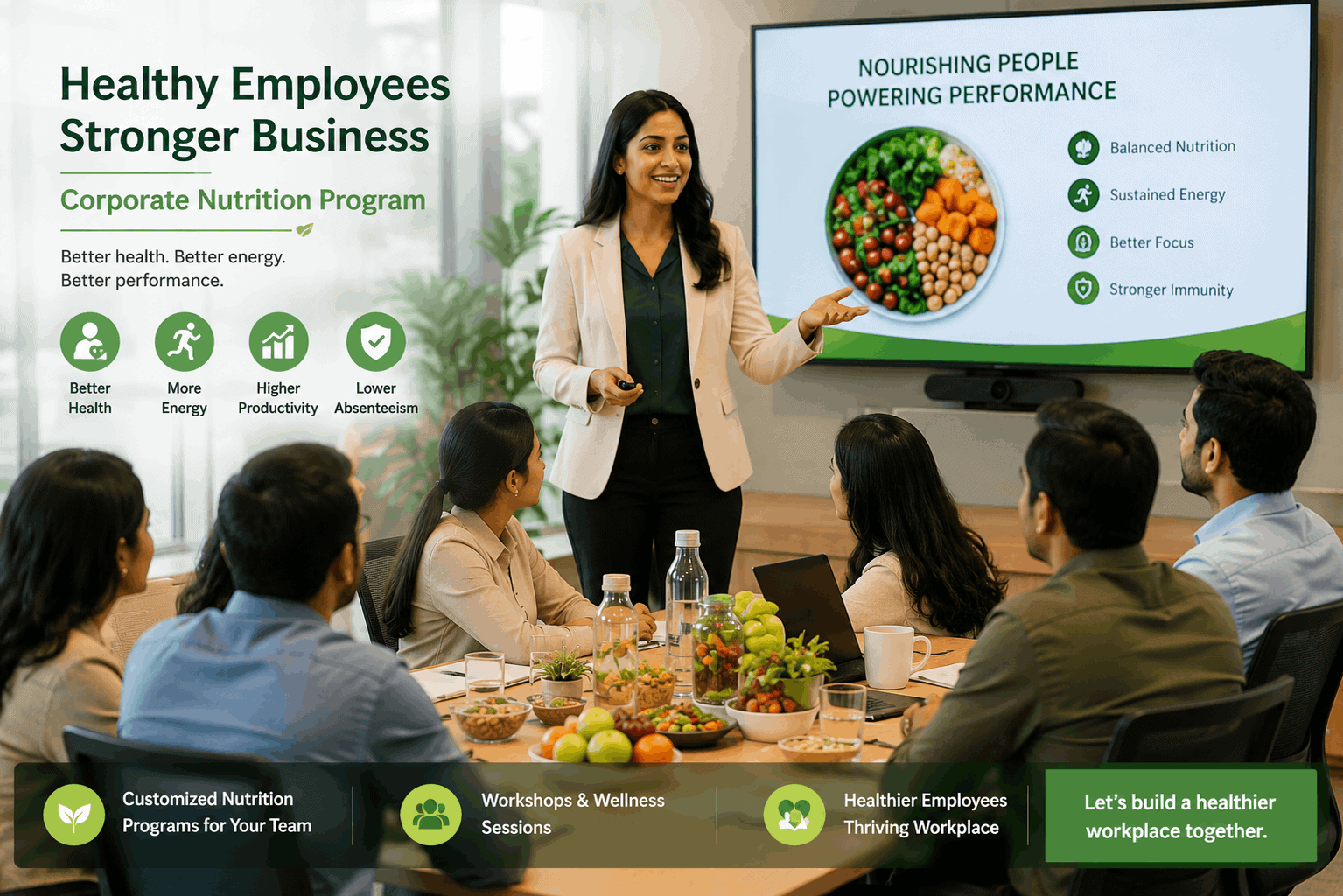
A corporate nutrition program is a structured employee wellness initiative where a qualified dietitian works with staff — individually, in groups, or both — to improve eating habits, manage weight and chronic conditions, and build sustainable healthy routines around the realities of office life.
This approach is consistent with guidance from the World Health Organization's Healthy Workplace Framework, which identifies nutrition as one of the core pillars of a health-promoting workplace, and the CDC's Workplace Health Program, which promotes science-based workplace health initiatives.
Who Delivers a Corporate Nutrition Program?
Unlike generic wellness content, an effective corporate nutrition program is delivered by a qualified corporate dietitian and tailored to your workforce's actual working conditions:
- Long hours at a desk — sedentary work that most nutrition advice doesn't account for.
- Canteen or delivery food — realistic meal options, not idealized home-cooked meals.
- Shift patterns — support that fits rotating or irregular schedules.
- Workplace stress — nutrition guidance that acknowledges how stress affects eating habits.
Why Workplace Nutrition Matters
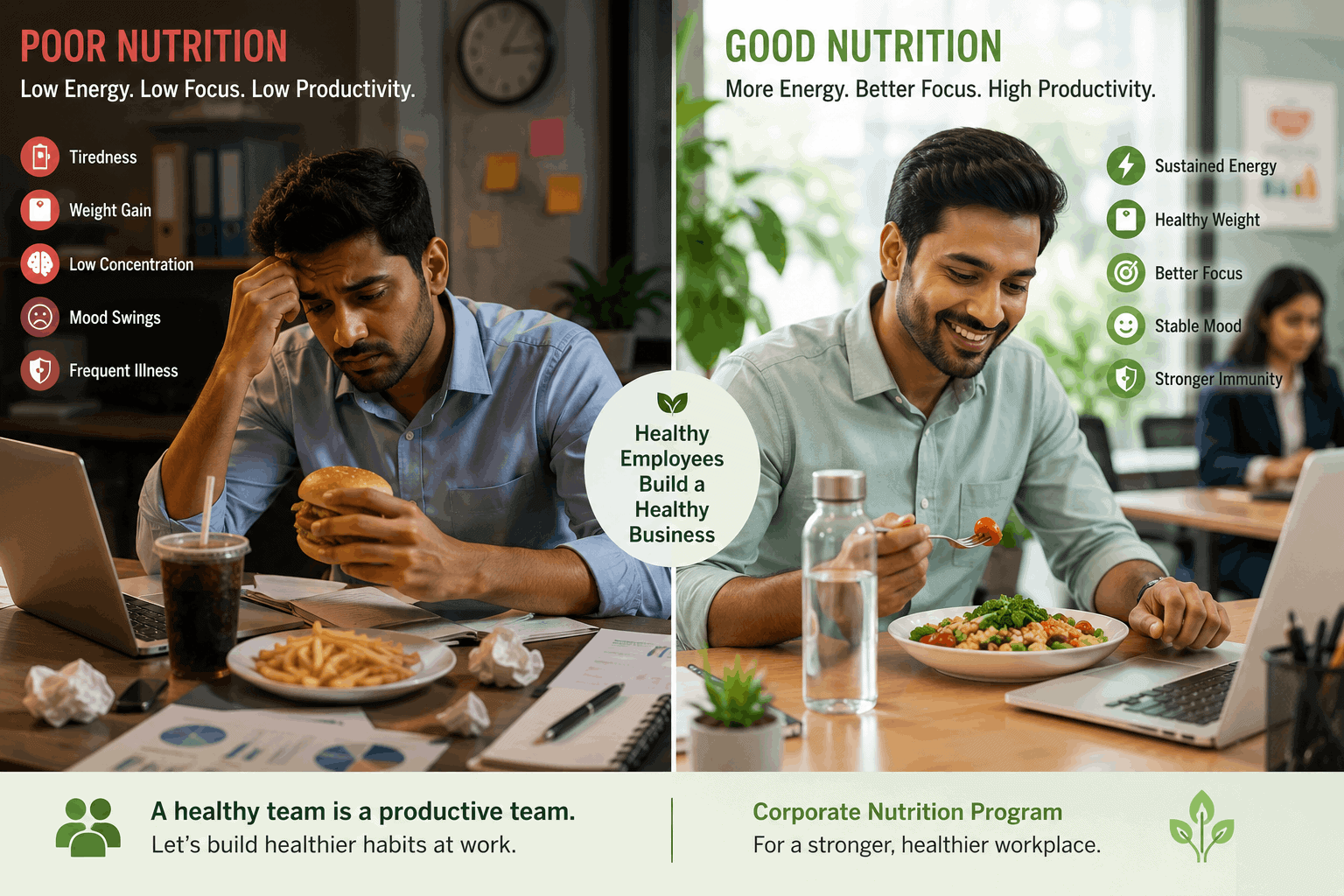
Most office employees today live a largely sedentary lifestyle — hours at a desk, minimal movement, and food choices driven by convenience rather than health.
Whether your workforce is fully in-office, remote, hybrid, or working shifts, the same patterns show up: skipped or rushed meals, excessive caffeine, low water intake, and snacking driven by stress rather than hunger.
The Cost of Poor Workplace Nutrition
Left unaddressed, poor workplace nutrition contributes to:
- Fatigue and inconsistent energy throughout the workday
- Poor focus and slower decision-making
- Long-term risk for obesity, diabetes, and high blood pressure
- Higher likelihood of stress-driven overeating or undereating
A recent umbrella review of workplace nutrition interventions found that structured programs can meaningfully improve employees' dietary habits (PMC, NIH) — which is exactly where a dedicated corporate nutrition program makes a measurable difference. If you're an individual looking for the same kind of structured support outside of work, our Individual Nutrition program follows the same evidence-based approach.
Benefits for Your Business
Employee wellness isn't just a benefit for staff — it shows up in business outcomes too. Research on evidence-based workplace health programs has found they can reduce employee health risks, improving performance and reducing health care costs over time (CDC-affiliated study, PMC):
Stable energy and better focus translate directly into workplace performance.
Healthier employees typically take fewer sick days over time.
Wellness benefits signal that a company invests in its people, supporting engagement and retention.
Preventive nutrition can reduce the likelihood of costly chronic conditions developing.
Visible wellness initiatives contribute to a healthier, more engaged team culture.
Wellness programs are increasingly expected by employees evaluating where to work.
Exact ROI varies by organization — factors like program design, employee participation, and existing health baseline all influence outcomes, so it's worth discussing your specific goals with a corporate wellness provider rather than assuming a fixed return.

What's Included in a Corporate Nutrition Program
Programs are typically built from a mix of these components, customized to company size and goals:
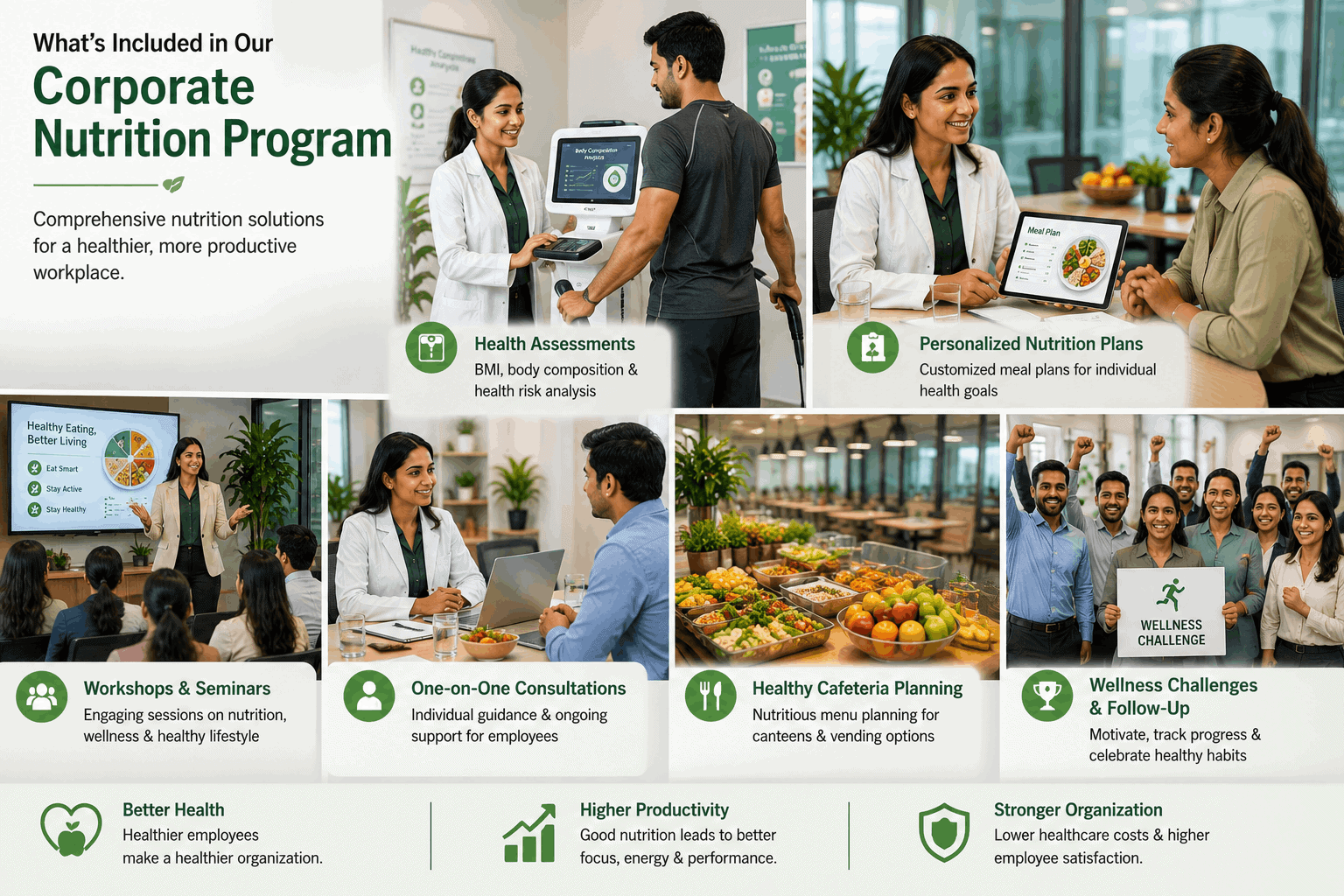
- Nutrition Workshops — group sessions on practical topics like healthy eating at work, meal planning, and portion control.
- Health Awareness Sessions — education on preventing lifestyle diseases like diabetes and high cholesterol.
- Employee Health Screening — basic health and BMI assessments to establish a starting baseline.
- Body Composition Analysis — more detailed metabolic health tracking for interested employees.
- One-on-One Consultations — personalized meal planning and nutrition counseling for individual employees, similar in depth to our Individual Nutrition service.
- Wellness Challenges & Campaigns — ongoing engagement initiatives to keep healthy habits active, not just a one-time event.
- Healthy Cafeteria Consultation — guidance for companies wanting to improve on-site food options.
Some companies also request condition-specific tracks — for employees managing diabetes or thyroid concerns, our Therapeutic Nutrition program can be layered into a corporate offering, and for organizations wanting to extend wellness benefits to employees' major life events, our Bride & Groom Wellness and broader Specialized Nutrition Programs are sometimes included as an added employee perk.
Eating Healthy at a Desk Job
Employees don't need a complete lifestyle overhaul to see real benefits — small, consistent changes make the biggest difference for desk-based work.
Simple Swaps for Office Habits
| Common Habit | Simple Swap |
|---|---|
| Vending machine snacks | Nuts, fruit, or roasted chickpeas kept at your desk |
| Multiple sugary coffees | Water or black coffee, with sugar in moderation |
| Skipping lunch during meetings | A planned, portable meal you can eat between calls |
| Sitting for 8+ hours straight | A short walk or stretch break every couple of hours |
| Food delivery out of convenience | Simple meal prep 2-3 days at a time |
Three Habits That Matter Most
According to Harvard T.H. Chan School of Public Health's Nutrition Source, consistent hydration and balanced, protein-containing meals support steadier energy throughout the day. For office workers specifically:
- Stay hydrated throughout the workday, not just at meals.
- Choose protein-containing snacks over sugary ones for sustained focus.
- Take short movement breaks every couple of hours, even just to stand and stretch.

Health Conditions It Can Help With
Corporate nutrition programs are especially valuable as preventive nutrition — addressing risk factors before they become diagnosed conditions, and supporting employees already managing:
The Academy of Nutrition and Dietetics emphasizes that registered dietitians play a valuable role in workplace wellness settings specifically because they can address these conditions with individualized, evidence-based guidance rather than one-size-fits-all advice. Employees managing a diagnosed condition often benefit from the deeper, ongoing support available through our Therapeutic Nutrition program.
Who Needs This — And Which Industries Benefit
Any organization with employees spending long hours at work benefits from structured nutrition support — but a few sectors see it come up especially often:
Company Size Doesn't Matter as Much as You'd Think
High-pressure, desk-heavy, or shift-based environments tend to see the clearest impact from a corporate nutrition program, simply because the baseline habits being addressed are the most disrupted in those settings. This applies equally to a 15-person startup and a 500-person enterprise — the program structure just scales differently.
How to Get Started
HR teams considering a program typically start with a conversation about company size, current wellness initiatives (if any), and specific goals — reducing sick leave, improving engagement, or simply offering a meaningful new benefit.
A Simple 3-Step Process
- Initial Consultation — discuss your company's size, goals, and current wellness initiatives.
- Program Recommendation — a provider recommends whether workshops, individual consultations, or a combined program fits best.
- Delivery — programs can usually be delivered online, on-site, or both, customized to your team.
Most corporate nutrition programs are customizable rather than one-size-fits-all — company size and budget shape the exact structure more than any fixed rule about "minimum employees needed." Some organizations start with a single workshop to gauge interest before committing to a longer-term program, which is a reasonable, low-risk way to test whether a corporate nutrition program is the right fit for your team. Want to learn more about our team first? Visit our About Us page or Meet Our Experts to see who you'd be working with.
Considering a wellness program for your team? Let's talk about what would actually work for your company's size, industry, and goals.
Book a Corporate ConsultationCorporate Nutrition Programs in Kerala
Companies in Kochi and across Kerala are increasingly recognizing workplace wellness as a genuine business priority, not just a perk.
The Significant Plate's Workplace Wellness program brings Master's-qualified corporate dietitians directly to your organization — whether you're a growing startup or an established business — with both online and on-site options. Head back to our homepage to explore all our services, or reach out directly via our Contact page to start the conversation.

How to Measure the Success of a Corporate Nutrition Program
A common concern from HR teams is whether a corporate nutrition program is actually working. A few practical ways to track this over time:
- Participation rates — how many employees engage with workshops, screenings, or consultations, and whether that number grows over subsequent sessions.
- Employee feedback — simple post-session surveys asking whether the content felt relevant and useful.
- Health screening trends — aggregate, anonymized changes in metrics like BMI or blood pressure across participating employees over time.
- Absenteeism data — whether sick-leave patterns shift over a longer tracking period, though this takes time and isn't attributable to nutrition alone.
- Retention and engagement surveys — whether wellness offerings come up as a positive factor in employee satisfaction or exit interviews.
No single metric tells the whole story on its own. The most reliable approach combines a few of these signals over a meaningful time period — typically several months, not a few weeks — rather than expecting an immediate, dramatic shift after one workshop.
Frequently Asked Questions
It's a structured workplace wellness initiative where a qualified dietitian helps employees improve eating habits and manage health, tailored to the realities of office work.
Sedentary desk jobs and convenience-driven eating contribute to fatigue, poor focus, and long-term health risks — workplace nutrition support directly addresses these patterns.
Any organization with employees who spend long hours at work — office-based, hybrid, remote, or shift workers — can benefit, regardless of industry or company size.
This varies by company goals — some run as a single workshop series, others as an ongoing program with ongoing check-ins. Duration is typically customized during initial discussions.
Common components include nutrition workshops, health screenings, body composition analysis, one-on-one consultations, and ongoing wellness challenges — see the "What's Included" section above.
Yes — programs are typically built around your company's size, industry, existing initiatives, and specific goals rather than delivered as a fixed package.
Yes — both formats are available, and many companies choose a mix depending on their workforce (fully in-office, hybrid, or remote).
Programs can typically scale from small teams to large organizations — the right format depends more on your goals and budget than a fixed employee count.
IT companies, startups, hospitals, banks, schools, and other desk-heavy or high-pressure environments tend to see the clearest impact, though any organization can benefit.
Book a consultation to discuss your company's size, goals, and current wellness initiatives — from there, a program can be recommended and customized for your team.